Premium Lens vs Standard Lens Implants: What Should You Choose?
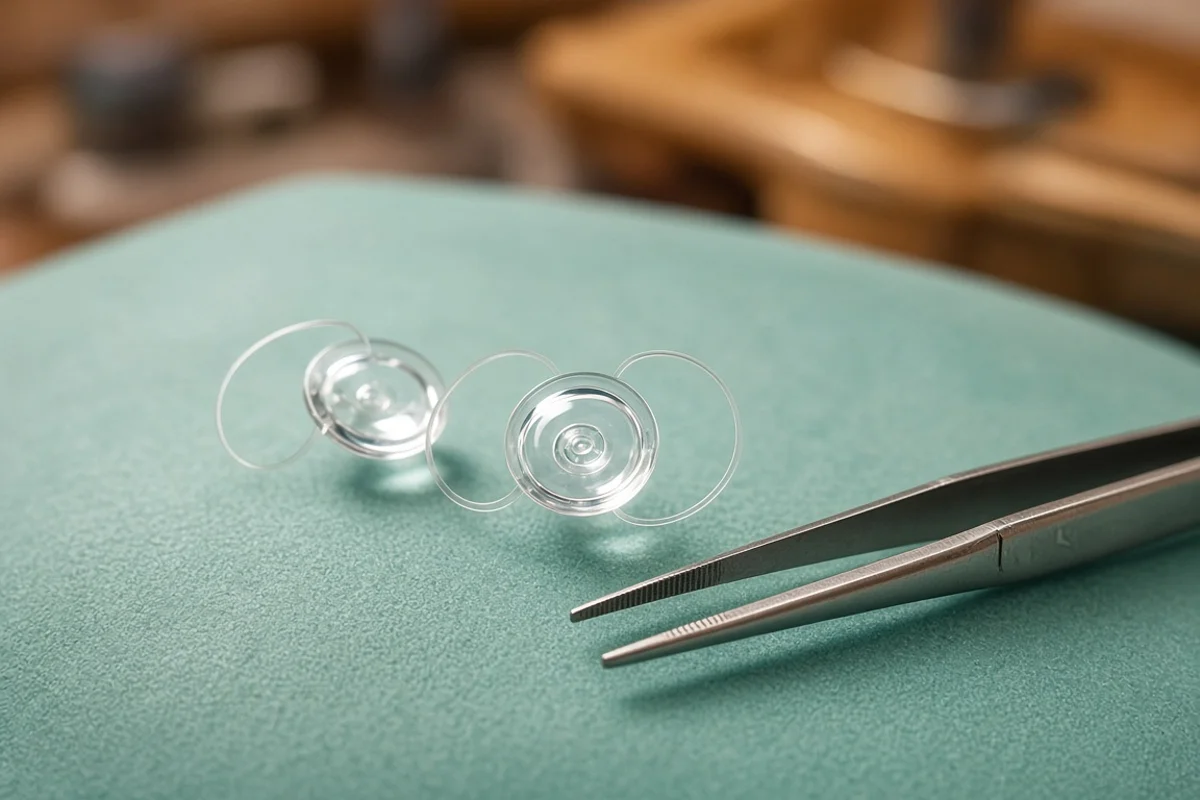
Choosing between premium lens vs standard lens implants comes down to one question: how much do you want to rely on glasses after surgery, and what trade-offs will you accept in return? A standard monofocal lens gives sharp vision at one distance, usually far, with reading glasses for close work. Premium lenses can reduce your need for glasses but may cause more halos or glare at night. The right lens is the one that suits your eyes and lifestyle, not simply the newest technology.
Mr Zine Elhousseini is a Consultant Ophthalmic Surgeon in London specialising in complex cataract surgery, refractive lens exchange, vitreoretinal surgery and medical retina. He sees patients at the Royal Free London in Hampstead and the Hospital of St John and St Elizabeth in St John’s Wood. Every patient is seen and treated by him personally, from the first lens discussion to surgery and aftercare.
What Is the Difference Between Premium Lens vs Standard Lens Implants?
All modern lens implants are small, foldable and placed inside the eye through a tiny incision once the natural lens is removed. They stay in place permanently and never need cleaning or replacing. The difference between premium lens vs standard lens implants is purely optical. It comes down to how many distances the lens can focus and whether it corrects extra problems such as astigmatism.
What Is a Standard (Monofocal) Lens Implant?
A standard lens implant is a monofocal lens, which focuses light at one distance. It is usually set for distance vision, so driving, television and recognising faces are clear without glasses. Reading glasses are then needed for close work. Some people choose near vision instead, and a few choose monovision, with one eye set for distance and the other for near.
Monofocal lenses give excellent contrast and crisp image quality, with fewer night-time effects than multifocal designs. For people who are happy to wear reading glasses, a monofocal lens is an entirely appropriate and highly effective choice.
What Counts as a Premium Lens Implant?
Premium lens is an umbrella term for implants that aim to reduce your need for glasses or correct extra focusing errors. The main types are:
- Toric lenses: correct astigmatism caused by an uneven cornea
- Enhanced monofocal lenses: give sharp distance vision with an extended intermediate range for screens and dashboards
- Extended depth of focus (EDOF) lenses: create one continuous focal zone from distance to intermediate, with light reading glasses usually still needed for small print
- Multifocal and trifocal lenses: split light between two or three focal points to give distance, intermediate and near vision
Mr Elhousseini offers enhanced monofocal, EDOF and multifocal lenses through refractive lens exchange. This uses the same technique as cataract surgery and can be chosen before a significant cataract develops.
Why Does the Choice Between Premium and Standard Lenses Matter?
Cataract surgery is usually done once in a lifetime for each eye. The lens chosen is meant to stay for life, and while lens exchange is possible, it is a more involved operation that surgeons prefer to avoid. That makes the decision worth careful thought, well before the day of surgery.
Cataract surgery is one of the most common operations in the country: NHS England reports more than 450,000 cataract operations a year. Yet in the premium lens vs standard lens implants comparison, there is no universally better option, only a better or worse fit for a particular eye and lifestyle.
What Are the Benefits and Trade-Offs of Each Lens?
Standard monofocal lenses offer excellent contrast, which matters for night driving and dim conditions. They carry a lower chance of glare and halos, give predictable vision with a short adjustment period and suit a wider range of eyes, including those with other eye conditions.
Premium lenses can reduce your need for glasses for everyday tasks, and sometimes for most tasks. Toric designs correct astigmatism, and EDOF lenses add useful intermediate vision for screens and cooking. They suit people whose work or hobbies make glasses impractical.
The trade-offs are real. Multifocal and trifocal lenses split light, which can slightly reduce contrast in low light. Moorfields Eye Hospital notes that 5 to 10% of people with trifocal lenses may see halos or glare around lights. Mr Elhousseini explains that with multifocal lenses, it can take several weeks for the brain to adjust. A small number of people never fully adapt, and glasses may still be needed for very fine print.
Who May Be Suitable for Premium Lens Implants?
Suitability depends on the health of the whole eye, not just the lens. A detailed assessment is always needed, and in some eyes a monofocal lens is clearly the safer choice.
Eye Health Factors
Premium lenses may be less suitable if you have macular disease, such as age-related macular degeneration or diabetic maculopathy. Significant glaucoma, corneal disease such as Fuchs’ dystrophy or keratoconus, previous retinal detachment, previous laser eye surgery and marked dry eye can also count against them. Large pupils and irregular astigmatism may increase the chance of night-time symptoms.
Lifestyle Factors
Your priorities matter too. Think about how much you drive at night, how long you spend on screens, how much you read in print and how you feel about reading glasses. Consider how well you cope with a period of adjustment. People who are very detail-focused sometimes do better with the predictable optics of a monofocal lens.
6 Steps to Choosing Between Premium Lens vs Standard Lens Implants
In 2026, choosing a lens remains a careful, step-by-step process:
- A full eye examination of the cataract, cornea, optic nerve and retina.
- Optical biometry to measure the eye and calculate lens power.
- Corneal mapping to measure astigmatism and detect irregularity.
- An OCT scan of the macula to reveal subtle retinal changes that could limit a premium lens.
- A tear film assessment, because dry eye can distort measurements and should usually be treated first.
- A discussion of your priorities, followed by a joint decision on the lens.
Where measurements are borderline or the retina has been treated before, a conservative choice is often wiser. Mr Elhousseini’s background in vitreoretinal surgery means retinal findings are weighed carefully. A lens that performs well in a healthy eye may underperform in an eye with macular changes.
What Does Lens Surgery Involve?
On his refractive lens exchange page, Mr Elhousseini describes the operation as a day-case procedure under local anaesthetic, taking around 15 to 20 minutes per eye. Light activities can usually resume within a few days, and vision takes two to four weeks to settle fully.
When comparing private lens surgery in London, ask exactly what is included, how many follow-up visits are covered and what happens if a laser touch-up or further treatment is needed. Value is best judged by the quality of the assessment and the honesty of the advice, not price alone.
Frequently Asked Questions
Which is better, a premium lens or a standard lens implant?
Neither is better for everyone. In the premium lens vs standard lens implants comparison, premium designs may reduce your need for glasses, while monofocal lenses offer very predictable vision with fewer night-time effects. The best option depends on your eye health, measurements and priorities.
Will I still need glasses after a premium lens?
Many people use glasses far less often, but freedom from glasses cannot be guaranteed. Light reading glasses may still help for small print, long periods of reading or poor lighting.
How long does it take to adapt to a premium lens?
With multifocal lenses, it can take several weeks for the brain to adjust. Halos and glare usually become less noticeable over this time, although a small number of people remain aware of them.
Can a lens implant be changed if I am unhappy?
Lens exchange is possible but is more complex than the original surgery and carries extra risks. This is why careful assessment and realistic expectations matter. Some focusing errors can instead be corrected with glasses or laser.
Do premium lenses cause permanent halos and glare?
Halos and glare are more common with multifocal and trifocal lenses. For most people they fade over weeks to months as the brain adapts, but a minority remain troubled, which matters if you drive a lot at night.
Do I need a cataract to have a premium lens?
No. Refractive lens exchange replaces a clear natural lens to reduce your need for glasses, often in people in their fifties or sixties. Suitability depends on your prescription, eye health and the balance of benefits and risks.
The Right Lens Is Chosen, Not Assumed
The choice between premium lens vs standard lens implants should rest on careful measurements and an honest conversation about your priorities. Mr Zine Elhousseini will assess your eyes in London and explain which lens will give you the most reliable result.